
Category
Sweeteners & Sugar Substitutes
Your reliable trading partner and supplier of sugar substitutes, sugar alternatives and sweeteners.


Sweeteners & sugar substitutes for the food industry
A broad portfolio for reduced-sugar and sugar-free product concepts
Sweeteners and sugar substitutes can fulfil various functions in food and drink formulations. Depending on the application, they influence, amongst other things, sweetness, energy content, volume, texture and mouthfeel. High-intensity sweeteners, polyols, sugars, dietary fibre and functional carbohydrates can be used individually or as part of blends.
We supply a versatile range of sweeteners, sugar alcohols, carbohydrates and dietary fibre for industrial applications. Our portfolio includes established raw materials such as acesulfame K, aspartame, sodium cyclamate, sodium saccharin and sucralose, as well as plant-based solutions such as stevia extracts. In addition, we offer, amongst others, erythritol, xylitol, maltitol, sorbitol, inulin, fructooligosaccharides, polydextrose, isomaltulose and trehalose.
The selection of a suitable raw material depends, amongst other things, on the desired sweetness level, the taste profile over time, the food matrix, the manufacturing process and the regulatory requirements of the respective target market.
High-intensity sweeteners
High-intensity sweeteners have a significantly higher sweetness than sucrose and are therefore typically used in comparatively small quantities. They are particularly suitable for applications where sweetness is required with a significantly lower energy content than that of sugar, and therefore play an important role in the development of reduced-calorie and sugar-free products. As they are used only in small quantities, they make no significant contribution to the mass or volume of the end product.
Our range includes:
- Acesulfame K (E 950)
- Aspartame (E 951)
- Sodium cyclamate (E 952)
- Sodium saccharin (E 954)
- Sucralose (E 955)
- Neohesperidin dihydrochalcone, or Neohesperidin DC for short (E 959)
- Neotame (E 961)
Acesulfame K, aspartame, cyclamate, saccharin and sucralose are among the intense sweeteners that have been in use for many years. They differ, amongst other things, in terms of sweetness intensity, the onset and duration of sweetness perception, temperature stability and any accompanying sensory notes.
In many product formulations, several sweeteners are combined. Such mixtures can combine different sweetening profiles over time or reduce the required dosage of individual components. The suitability, dosage and regulatory approval must be assessed by the food manufacturer for the specific formulation, application and target market.
Plant-based sweetening solutions
Our range also includes:
Stevia products can vary significantly in terms of sweetness and sensory profile, depending on their composition, purity and manufacturing process. For steviol glycosides, the exact designation under food law must be checked against the relevant product specification and manufacturing process.
Similarly, for monk fruit products, regulatory approval depends on the specific product, its intended use and the target market. Inclusion in our range therefore does not constitute a general statement regarding approval or application.
Polyols and sugar substitutes
Polyols, also known as sugar alcohols, often possess further technological properties in addition to their sweetening effect. Depending on the product, they can influence volume, texture, moisture retention, mouthfeel or a cooling effect. However, polyols are not inherently calorie-free and vary in terms of both their energy content and their glycaemic index. Whilst, for example, erythritol has only a minor effect on blood sugar levels, other polyols may have a more pronounced glycaemic effect.
Our portfolio includes:
Sugar and functional carbohydrates
In addition to traditional sweeteners, we stock a range of sugars and carbohydrates that can influence not only the flavour but also the body, texture, solubility, browning and processing properties of a product.
Dietary fibre and prebiotic carbohydrates
Some products in our range are not primarily intended for sweetening. However, they can help to enhance volume, dry matter, texture or fibre content in reduced-sugar recipes.
Different sweetening profiles over time
Sweetness is not perceived solely on the basis of its maximum intensity. The onset of sweetness perception, the peak of sweetness and the aftertaste can also vary between different sweeteners.
Some intense sweeteners have a comparatively rapid onset of sweetness, whilst others are perceived more slowly or have a longer-lasting aftertaste. Stevia and monk fruit products can also differ significantly in terms of sensory properties, depending on the quality, purity and composition of the extract. A schematic sweetness curve can illustrate these fundamental differences.
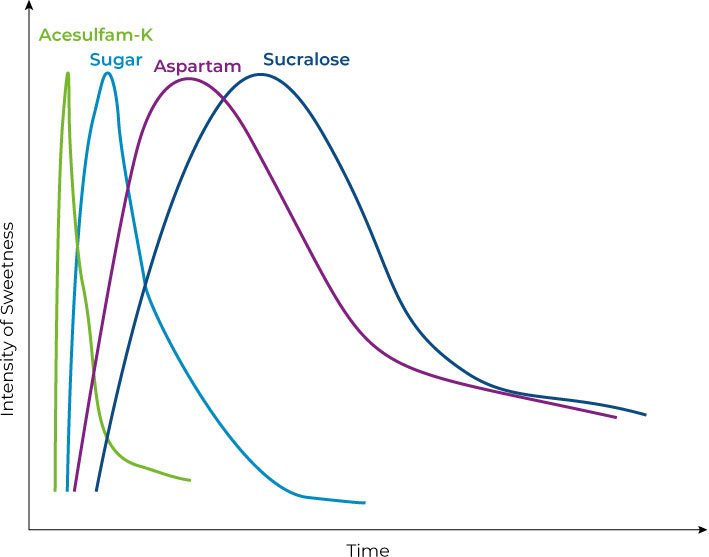
Schematic diagram for general guidance
The actual sensory profile may vary depending on raw material quality, concentration, food matrix, pH, temperature and processing. This diagram does not constitute advice on formulation, dosage or application.
The information provided is intended solely for general product information. The user is responsible for verifying the suitability, dosage, labelling and regulatory compliance of the respective product for the specific application and the relevant target market.
FAQ - What we are often asked
ACT is headquartered in Hamburg, Germany, and has 14 locations worldwide. Our interactive map shows you all locations and their contact details. So you can reach us at any time.
We have been your reliable partner for high-quality additives for over four decades. As a Hamburg company, we offer quality raw materials for food, feed, cosmetics, pharmaceuticals and technical applications.
Follow this link to get an overview of the different sectors that we already supply with our quality raw materials.
Our long-term partnerships build on our consistently high quality and customer satisfaction. Our internal quality management department continuously checks the approval of suppliers and raw materials. We work with independent test laboratories to ensure meaningful monitoring. That is our quality promise!